
Interior Designer Miami FL: How to Vet One Before You Hire
Miami's interior designer listings sort firms by budget, style and awards. None of them show who decides the wall, the window height or the zoning limit before a single finish gets chosen. Here is how to look past the directory.
Luxom Studio · LUXOM Developments
· 7 min read · Last reviewed
Key takeaways
- Searching interior designer Miami FL mostly returns individual firm homepages next to two large roundups, Houzz's 1,499 firm directory and Architectural Digest's 46 name AD PRO list, neither of which explains what any firm's process actually controls.
- None of the reviewed Miami firm pages name a specific zoning code, lot constraint or structural decision that was fixed before an interior finish was chosen.
- SDH Studio's own published FAQ asks how much it costs to hire an interior designer in Miami and does not answer with a number, only a service line called budget formulation and management.
- Site and structure decisions, where a wall sits, how tall a window can run, what a floor is built to hold, get fixed before a single interior finish is chosen on a design-build project.
- Miami 21's T3 zoning transect bounds a Coconut Grove lot before interiors even begin: 5,000 square feet minimum in T3-L, 6,500 in T3-O, with lot coverage capped around 45 to 50 percent.
Editor's note
Search interior designer Miami FL and the results split into two kinds of page. Individual firm homepages, Nar Design Studio, SDH Studio, Natalia Neverko Design, each making its own case for luxury and credentials. And two large roundups, Houzz's directory of 1,499 professionals and Architectural Digest's AD PRO list of 46 names, both of which sort firms by filter rather than explain what any of them actually do.
What none of those pages show is the decision that happens before a single finish is chosen: who decided the wall, the window height, the floor level the interior has to work within. That decision belongs to construction, not decoration, and it is the gap this guide fills.
Who is the best interior designer in Miami?
It is the wrong question to ask a directory. Houzz's listing filters 1,499 Miami interior designers and house decorators by project type, style, budget tier and business highlights like "responds quickly" or "provides 3D visualization," with no field describing how any of them actually work. Architectural Digest's AD PRO directory profiles 46 names with a founder, a project photo and a paragraph of bio, grouped by stylistic niche, hospitality-influenced, old-world, biophilic, maximalist. Neither page tells you what a firm controls on your actual build.
Individual firm pages are more specific but share the same blind spot. SDH Studio publishes a documented six-phase process, Programming, Concept Design, Design Development for social and private areas, Project Administration, Furnishing and Staging, and the Programming phase has the team "undertake a thorough review of the project site, the architectural design, and the building plans" before any interior concept begins. That is a review step. The site, the structure and the building plans are already fixed by someone else before SDH's interior process starts. Nar Design Studio states plainly that it pairs its interior designers with "trusted partners" for execution, which keeps design and construction as two separate relationships you coordinate between.
So the honest answer to who is best is: ask which firm also controls the structure the interior sits inside, not which firm has the most awards. Nar Design Studio names recognition from the German Design Awards, SBID International Design Awards and Florida Design Awards. Credentials like that tell you a firm's design is respected. They do not tell you whether the same people who chose the stone also decided how tall the window beside it could run.
What interior designers in Miami actually charge
Pricing is the second question every comparison runs into, and almost nobody answers it with a number. SDH Studio's own published FAQ lists heading nine as "How much does it cost to hire an interior designer in Miami for a luxury home?" and answers it with a service line, budget formulation and management, not a figure. Houzz sidesteps the same question with a four-tier budget filter ($ to $$$$) instead of a price. Across the reviewed Miami pages, fee structure is described as a percentage of project cost, a flat design fee, or an hourly rate, with the actual number left out because scope varies too much between a single room refresh and a ground-up residence.
What is worth comparing across firms is not a headline number but what the fee buys. A design-only engagement gets you drawings and specifications, and you manage procurement, freight and installation yourself. A full-service fee usually folds in sourcing, ordering, tracking and the install day. Ask every firm on your shortlist for that breakdown before you weigh one quote against another, because two very different scopes can show up on paper as the same hourly rate.
The decision no directory shows: who fixes the wall before the finish
This is the gap across every page reviewed for this guide, from the 1,499-firm Houzz listing down to the individually branded studios. None of them ties the interior design decision to the structural or zoning decision that precedes it. On a Luxom project, those two decisions get fixed together, by the same team, before a single finish is chosen: site and structure decisions, where a wall sits, how tall a window can run, what a floor is built to hold, are fixed before a single interior finish is chosen. A glazing wall sized for a view corridor, or a floor level set by Florida's hurricane requirements, decides what the room behind it can hold before any material gets selected.
That sequencing is also why a design-build studio and an architect-only arrangement produce different interiors even on paper-identical briefs. When the designer works inside walls someone else already drew, the room is optimized after the structural decisions are locked. When the same team draws both, the interior shapes the structural decision instead of inheriting it.
Miami 21 bounds the site before interiors begin
In Coconut Grove specifically, the constraint is not abstract. Coconut Grove sits inside the City of Miami and is governed by Miami 21, mostly the T3 single family transect, where the minimum lot is 5,000 square feet in T3-L and 6,500 square feet in T3-O, with lot coverage capped around 45 to 50 percent. That code sets the building envelope, how large the structure can be, where it can sit on the lot, before an interior designer or an architect draws a single room. None of the five Miami interior-design pages reviewed for this guide names a specific zoning code, lot minimum or coverage cap for any neighborhood they serve. A designer who also owns the design-build process treats that constraint as a starting input, not a surprise discovered mid-project.
One material program, decided before furniture
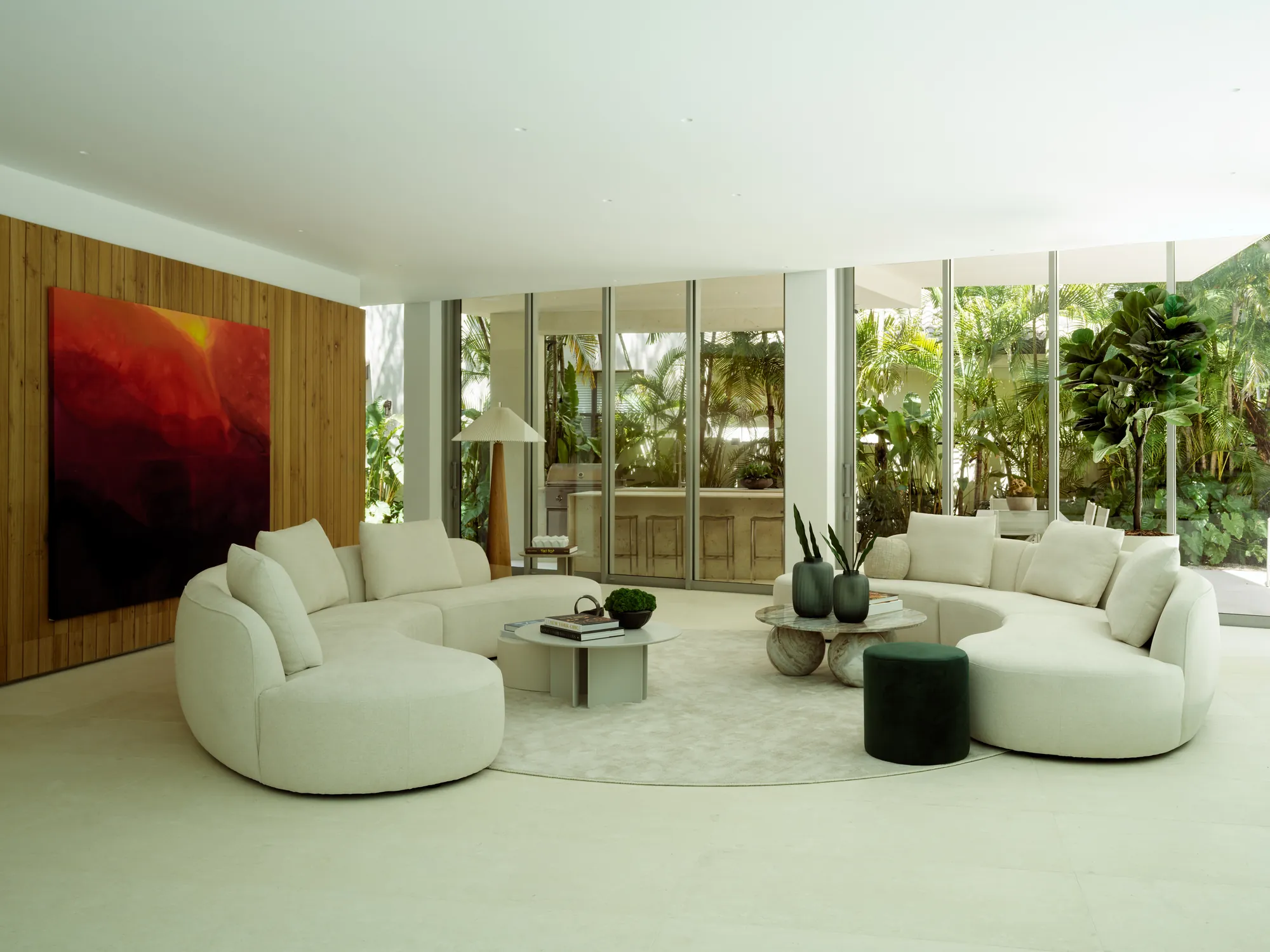
The same sequencing shows up at the finish level, not just the structural one. At Luxom, the uniting thread in a finished room is usually a material decision made before a single piece of furniture is bought: one timber species, one stone, one plaster. In the finished Onaway Residence living room in Coconut Grove, curved cream sofas and stone coffee tables sit against a wood paneled wall, with one deliberate painting left out of the material palette. That rule gets set at the same table where the architecture is decided, which is part of why it reads as considered rather than assembled, and it holds whether the final palette lands on an organic modern material mix or something quieter. The same material-first logic extends to outdoor rooms in Miami's climate, where marine grade stainless steel and sealed natural stone are survival decisions, not style choices, and it extends indoors too: a home theater built into a Miami house needs its acoustic structure decided before any finish is chosen, the same order every other room follows.
The 3-5-7 rule, and where it actually fits
Among the people-also-ask questions attached to this search is the 3-5-7 rule, a styling guideline for arranging objects on a shelf or console in groups of three, five or seven, since odd-numbered, varied-height groupings read as more natural than even pairs. It is a real, useful rule, and it belongs at the very end of the process, after a room is built, furnished and ready for the last layer of styling. It has no bearing on the decisions that actually determine whether a Miami interior works: wall placement, window height, floor elevation, material program. Our guide to building an interior moodboard that holds up covers the decisions that come well before any shelf gets styled.
How to vet an interior designer in Miami before you hire
Four questions separate a directory listing from a firm that can actually deliver the structural and interior decision together.
Ask who decides the wall. If the answer is an architect you have not met yet, or a separate contractor hired after design, the interior team is working inside limits it did not set.
Ask for a zoning or code constraint on a real project, by name. A firm that has navigated Miami 21's T3 transect, hurricane glazing requirements or flood elevation rules on an actual Coconut Grove address can describe the constraint specifically. A firm that only decorates will not have one to name.
Ask to see one finished room traced from site survey to furnished space, not a styled photo. The Onaway Residence living room is one example of a material program decided before furniture; ask any firm on your shortlist for their equivalent.
Ask what the fee includes before comparing numbers. A design-only quote and a full-service quote that includes procurement and installation are not comparable figures, even when the hourly rate looks similar.
If you are scoping a Coconut Grove or Miami project and want the structure and the interior decided by the same team from the first sketch, start the conversation through our contact page, or see how the process lands in built work on the projects page.
Pull quote
A directory tells you who is available. It does not tell you who decided the wall before the room behind it was designed.
Filed under
Questions about interior designer miami fl
01Who is the best interior designer in Miami?
There is no single best interior designer in Miami, and any roundup that ranks one is sorting by award history, press coverage or follower count, not by what the firm actually controls on a build, a distinction covered in who is the best interior designer in Miami?. The real question to ask a shortlist is narrower: does this designer only specify finishes on a space someone else already fixed, or does the same team also decide the wall, the window and the structure the room sits inside. Nar Design Studio and most firms listed on Houzz or Architectural Digest's AD PRO directory design interiors within architecture and construction that has already been locked in elsewhere. A design-build studio decides both together, and that distinction matters more than any award once hurricane glazing limits, floor elevation or a zoning setback are in play.
02How much do interior designers charge in Miami?
Most published Miami interior design pages do not disclose a number, the gap covered in what interior designers in Miami actually charge. SDH Studio's own FAQ lists the question how much does it cost to hire an interior designer in Miami for a luxury home as a heading, then answers it with a service description, budget formulation and management, rather than a figure, the same way Houzz filters by a four tier budget scale instead of a price. That is typical for the industry: full-service fees are usually structured as a percentage of project cost, a flat design fee, or an hourly rate, and the number depends on scope, square footage and whether procurement and installation are included.
03What is the 3-5-7 rule in interior design?
The 3-5-7 rule is a quick styling guide for arranging objects, usually on a shelf, console or coffee table: group items in sets of three, five or seven, since odd numbers of varying height and size read as more natural and considered than even, symmetrical pairs, as laid out in the 3-5-7 rule, and where it actually fits. It is a decorating rule, applied after a room is built and furnished, not a rule that governs layout, structure or materials. It is worth knowing if you are styling a finished shelf, but it has no bearing on the larger decisions, where a wall sits, what a floor is built to hold, that a Miami project needs settled long before any styling begins.
04How is a luxury interior designer different from the firm managing my construction?
On most Miami projects they are two different relationships, the distinction this guide calls the decision no directory shows: who fixes the wall before the finish. The interior designer specifies finishes, furniture and lighting inside a space whose walls, window openings and structural limits were already set by an architect and a separate contractor. Nar Design Studio describes this directly, pairing its interior designers with trusted partners for execution, which keeps design and construction as separate contracts you coordinate between. A design-build studio removes that seam: the same team that decides where a wall sits also decides what finish goes on it.
05When should I bring an interior designer onto a Miami project?
Before the architectural drawings are fixed, not after, the vetting checklist covered in how to vet an interior designer in Miami before you hire. Ceiling heights, window placement, floor levels and the position of structural walls decide what an interior can become, and all of them are cheap to adjust on paper and expensive to change once framing starts. SDH Studio's published process begins its own "Programming" phase by reviewing architectural plans already fixed by someone else; a design-build team brings the designer in before that point instead. If you are renovating, the equivalent moment is before demolition, while plumbing and electrical can still move.
Explore the portfolio
Projects to see


Talk to the studio
If this belongs in your home, our studio will draw the plan.
Initial conversation, 30 minutes. We listen to the brief and respond with a scoped proposal within five working days. You can also read the services page for typical timelines and fees.
Written by Luxom Studio · LUXOM Developments
The design and development studio behind LUXOM residences in Coconut Grove, Miami
Keep reading
From the journal

Interiors · Oct 2, 2026 · 4 min
Navy Sofa Styling Ideas: Material Before Color
Every guide hands you five or six color schemes to choose between. The decision that actually matters is the stone, wood and metal already built into the room, chosen before the sofa.
Interiors · Sep 13, 2026 · 5 min
Your rug should not match your furniture. It should talk to it.
The generic advice says find one matching thread. What that actually looks like in a finished Luxom room is a planned material conversation, not a matched fabric swatch.
Interiors · Sep 13, 2026 · 5 min
Three Rules for Mixing Wood Tones Without Getting It Wrong
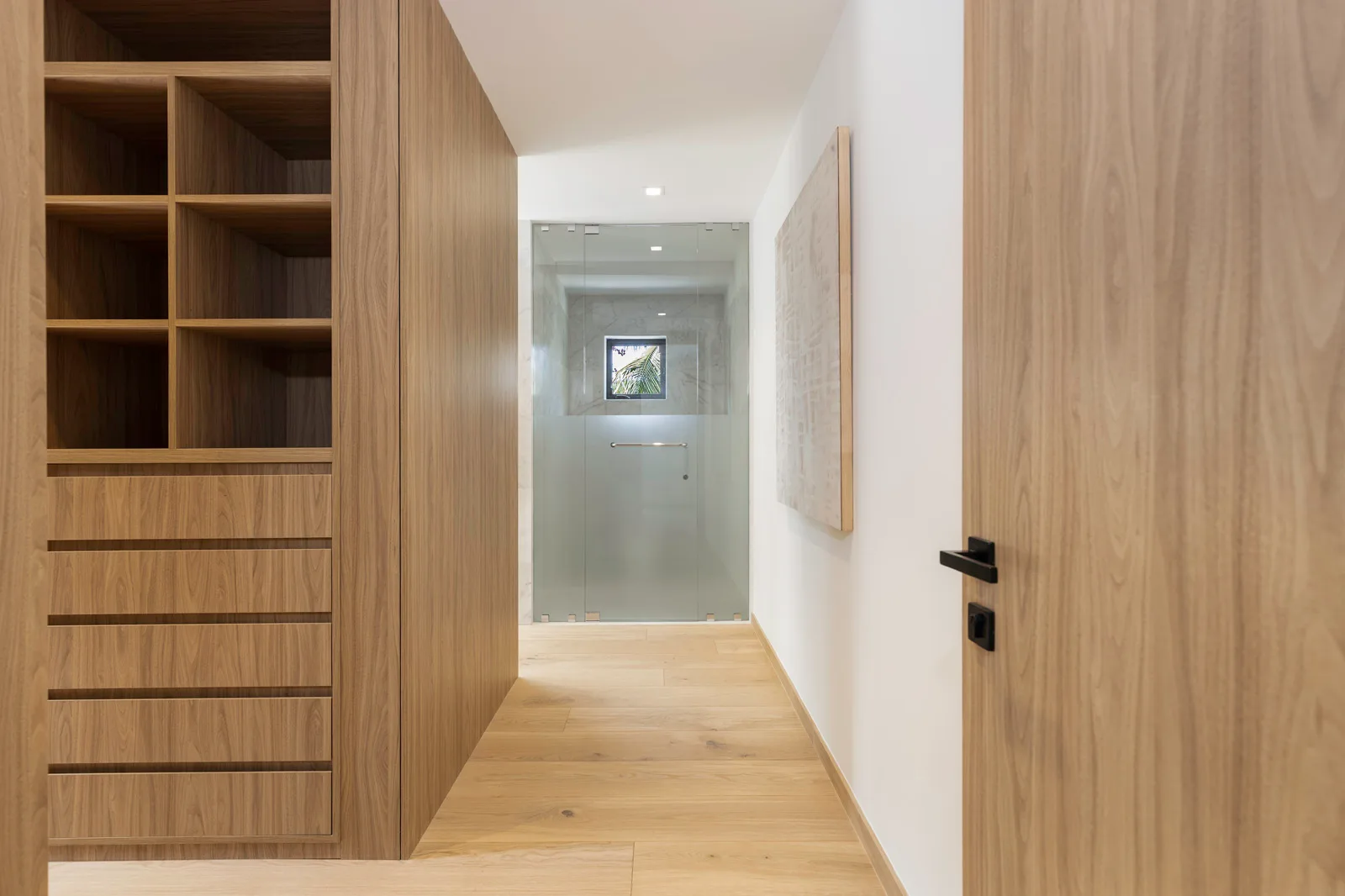
Never let every wood match, pick one lead wood, and watch the undertone. Two or three tones is enough, and here is what that looks like built into a real Luxom hallway.